
Benafica is a health benefits and insurance company that helps employers offer flexible, tax-free health reimbursement plans instead of traditional group health insurance.
ICHRA Contribution Strategies

On This Page
Contribution Strategies
Every ICHRA design comes down to two decisions: how much you give, and how you divide it across your people. Once you set a strategy it holds for the plan year, so it’s worth getting right the first time.
Age-based contributions
This strategy ensures greater equity across your workforce.
- Set a target coverage level for your workforce (e.g. 75% of a Gold plan)
- Every employee gets the same purchasing power
- Dollar amounts differ by employee age and location (because insurance premiums vary by age and location)
Flat-dollar contributions
This strategy can be simpler to understand b, but it can disadvantage older employees and those living in areas ut it can disadvantage older employees and those living where insurance is more expensive.
- Set a flat dollar amount for all employees (e.g. $500)
- Each employee will receive the same dollar amount to buy health insurance
The 3:1 Rule If you vary the allowance by age, the amount offered to the oldest participant in a class cannot exceed three times the amount offered to the youngest participant in that class.
Age-Based Starts with a Benchmark Plan
The benchmark is the lowest-cost silver plan available in an employee’s local market. It sets the minimum needed to satisfy IRS affordability rules if you’re an applicable large employer. Everything else is built up from there.
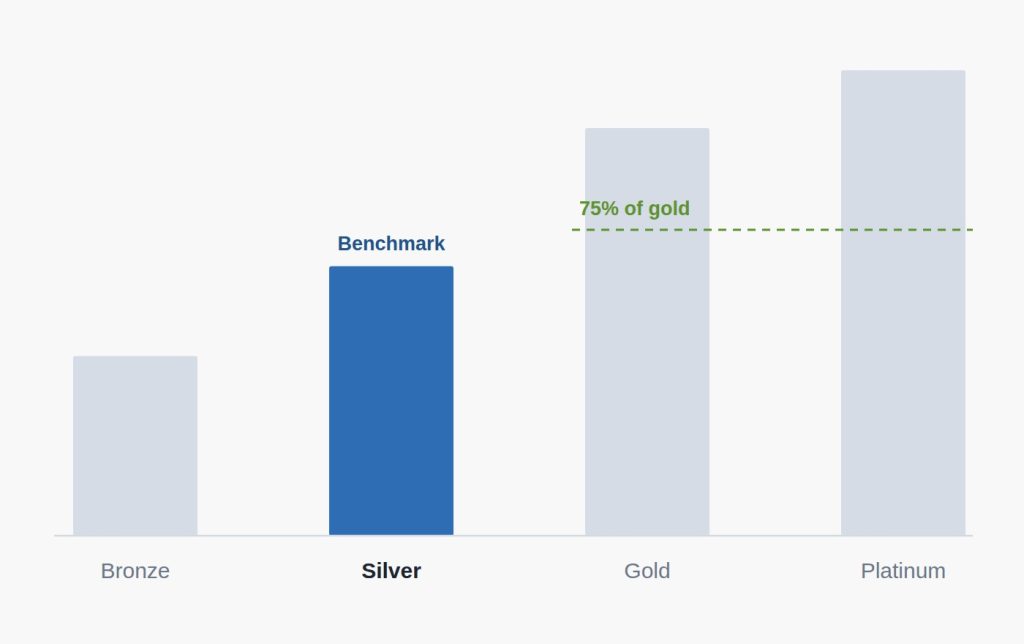
A common step up — three-quarters of a mid-tier gold premium.
Think of this as a ceiling, not a guarantee. You're modeling the most you could spend at a given percentage. Actual spend usually lands lower, depending on enrollment and which plans employees choose.
What Happens to Leftover Money?
Your last design decision: does unused allowance stay with the company, or can employees put it toward other qualified healthcare costs? Here’s how a leftover balance moves through each option.
Premiums only
Whatever an employee doesn’t spend on their monthly premium stays with the company. Simple to administer, and total spend never exceeds premium reimbursements.
Premiums + qualified medical expenses
Leftover allowance can go toward other IRS-qualified costs — functioning a bit like an HSA without the bank account. Employees can submit costs such as:
- Doctor visit copays
- Prescription drug costs
- Other IRS-approved medical expenses
What Changes at Renewal?
The reassuring part of an ICHRA is that your number doesn’t move unless you move it. The part people miss is that everything around it does.
- Premiums change. The plan that cost $520 this year may cost $560 next year. Your allowance buys less unless you adjust it.
- The affordability threshold changes. The percentage is indexed annually. A design that passed comfortably can fail on the same dollar allowance.
- Your workforce changes. A new hire at either end of the age range can shift a 3:1 ratio that had room in it.
- The notice deadline doesn't move. Whatever you decide has to be communicated at least 90 days before the plan year starts — so the modelling conversation happens in late summer, not December.
Contribution Strategies FAQ
Is there a minimum ICHRA contribution?
No. There’s no federal floor and no cap. You can offer any monthly amount you choose. What constrains the number in practice is the affordability test if you’re an applicable large employer, and what coverage actually costs in your employees’ counties.
Can we give different amounts to different employees?
Yes, in three ways: by permitted employee class, and within a class by age and by family size. You cannot vary the allowance by seniority, job title, performance or individual negotiation.
How much can the allowance vary by age?
The oldest participant in a class can be offered up to three times what the youngest participant in that class is offered. The ratio is measured within the class, against your actual youngest and oldest participants — so it can tighten when you hire.
Should we go flat-dollar or age-based?
It depends on the spread of your workforce. Flat is simpler and reads as equal; age-based tracks what coverage actually costs and usually costs less in total because you’re not overfunding younger employees. We model both against real premiums in your counties before you decide.
What happens to allowance an employee doesn't use?
It stays with you. An ICHRA is a notional arrangement rather than a funded account, so you only pay out what’s actually claimed and substantiated. Employers may allow unused amounts to roll over within a plan year, but nothing requires it.
Do we have to change the allowance every year?
No, but you should re-test it every year. Premiums move, the affordability threshold is indexed annually, and your workforce changes. Keeping the same dollar amount is a decision, not a default.
Can we offer more to employees with families?
Yes. The allowance can increase with family size, applied consistently across the class. It can’t be discretionary or negotiated case by case.
Related ICHRA Guides
Let's Model Your Number
Send us your census and your counties and we’ll model flat-dollar and age-based side by side, against real premiums — and show you what each one does to affordability before you commit to anything.