
Benafica is a health benefits and insurance company that helps employers offer flexible, tax-free health reimbursement plans instead of traditional group health insurance.
ICHRA for Restaurants & Hospitality Businesses

Flexible, tax-free health benefits built for the realities of foodservice: tipped workers, part-time staff, seasonal hires, and multi-location operations.
- Offer benefits to part-time and tipped employees without a group plan
- Tailor allowances by employee classes
- No minimum participation, no carrier enrollment thresholds
Hotel, brewery, or catering company? See who we work with 🠛

Health benefits are the hardest problem in hospitality
Restaurants are among the largest private employers in the country, and among the least likely to offer health benefits. The math has never worked: thin margins, high turnover, and a workforce split between tipped servers, hourly kitchen staff, salaried managers, and seasonal hires. Traditional group plans need minimum participation, charge the same rate regardless of role, and fall apart when half the staff turns over in a year.
The result is a coverage gap that isn’t just a benefits problem. It’s a hiring and retention problem, in an industry where both are already the hardest part of the job.
85 employees · 4 rooftops · 2 states
Harbor Street Kitchen
Full-service · Minneapolis
28 staff
Harbor Street Taproom
Bar & patio · St. Paul
19 staff
Harbor Street Café
Fast casual · Edina
16 staff
Harbor Street Kitchen
Full-service · Hudson
16 staff
32%
of hospitality workers have healthcare coverage, compared to 77% across private industry
— Bureau of Labor Statistics
79.6%
Average annual employee turnover rate in restaurants over the past decade
— BLS / Toast
$5,864
Average cost to replace a single restaurant employee: recruiting, training, and lost productivity
— Cornell Center for Hospitality Research
Built for all of hospitality
Food service is where the workforce problem shows up most sharply, but the same structure (mostly hourly, heavily part-time, seasonal swings, and often more than one site) runs through hospitality generally.
Restaurants
- Full-service restaurants
- Quick-service and fast casual
- Fine dining
- Family dining and diners
- Pizzerias and delivery concepts
- Franchise restaurant groups
- Multi-concept restaurant groups
- Ghost kitchens and delivery-only brands
- Food trucks and mobile food service
Bars, breweries & cafés
- Bars and taverns
- Breweries and taprooms
- Wineries and tasting rooms
- Distilleries and cocktail bars
- Coffee shops and cafés
- Bakeries and specialty food retail
Lodging & venues
- Hotels and motels
- Resorts and lodges
- Bed and breakfasts and inns
- Event venues and banquet halls
- Country clubs and golf courses
- Casinos and gaming hospitality
Food service operations
- Catering companies
- Contract food service and corporate dining
- Senior living and healthcare dining
- School and campus dining services
- Stadium, arena, and venue concessions
- Commissaries and food production kitchens
Why ICHRA works for restaurants
Set a fixed monthly allowance for each employee class. Employees choose their own individual health plan and get reimbursed tax-free. You control costs. They get real coverage, even your part-time dishwasher and your tipped bartender.
Built for tipped, part-time, and seasonal workers
Group plans have minimum participation requirements most restaurants can’t hit. ICHRA has none. Offer benefits to part-time servers, seasonal event staff, and full-time kitchen crews, all under one program. Reimbursement is a fixed amount by class, so a slow month of tips doesn’t change what an employee receives.
One program across every location
A single neighborhood restaurant or a multi-concept group across several states: ICHRA works everywhere. Employees shop plans in their own market with local provider networks. No multi-state carrier networks, separate group plans per location, or coverage employees can’t use.
Different allowances for different groups
Structure allowances using ICHRA’s 11 permitted employee classes:
- Full-time vs. part-time
- Hourly vs. salaried
- Geographic location
- Seasonal vs. year-round
Allowance or tax credit? It’s one or the other
Employees can’t collect an ICHRA allowance and a marketplace subsidy. Which is better depends on household income and the allowance you set, and a large share of hospitality staff sit in the income band where tax credits are most generous.
The employee takes your allowance
They’re not eligible for a premium tax credit for any month the offer applies. They use your money toward a plan they choose, and for most employees at or above a moderate wage, this is the better outcome: money they wouldn’t otherwise have.
They can opt out and take the credit
They decline the ICHRA and claim a premium tax credit instead. They keep the subsidy, but receive nothing from you. For a lower-wage employee with a large credit, this can genuinely be the better deal.
Group plan vs. ICHRA for restaurants
| Traditional group plan | ICHRA with Benafica | |
|---|---|---|
| Participation minimums | Carriers require 50–75% enrollment, hard to hit with part-time and tipped staff | No minimums. Even if one employee enrolls, the plan works |
| Part-time and tipped workers | Often excluded entirely, or can’t afford the employee share | Included as their own class with a tailored allowance |
| Multi-location operations | Requires multi-state networks or separate plans per market | Employees shop local plans in any state. One program covers all locations |
| Cost control | Premiums rise annually; one bad claims year spikes renewal | Set a fixed monthly allowance per class: predictable and budgetable |
| Turnover impact | Paying for coverage on employees who leave within weeks | Allowance stops when employment ends. No wasted premium |
| Employee choice | One or two plan options for everyone | Each employee picks a plan that fits their needs, providers, and family |
| Administration | Carrier negotiations, renewals, census management | Benafica handles enrollment, compliance, and reimbursements |
A restaurant group, by the numbers
Illustrative example. Actual allowances depend on your workforce, locations, and budget.
Full-time, salaried
GMs, operations managers, office staff
$500/mo
Individual
$1,000/mo
Family
At the $200 and $150 levels, some part-time and seasonal employees may be better off declining for a tax credit. We model this with you before launch.
Each employee shops for an individual plan on the ACA marketplace or through a carrier in their state. The restaurant group controls spend by class, Benafica manages enrollment and compliance through BEN360, and employees get coverage they actually chose, not coverage they were defaulted into.
We handle the paperwork, you run your business
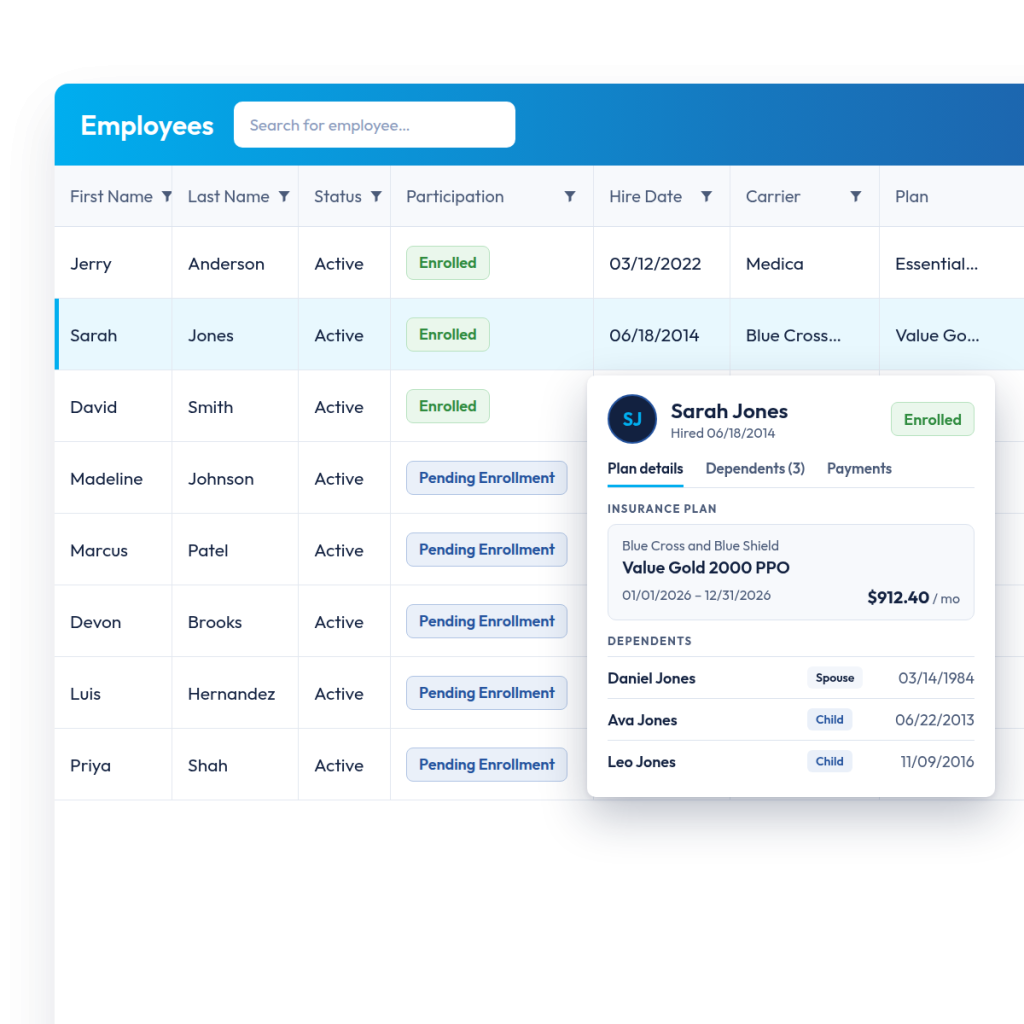
Benafica’s in-house ICHRA platform gives you full visibility across every location, with enrollment status, payment tracking, and on-demand reporting. Many hospitality employees have never bought insurance before, so we support them directly.
- Real-time enrollment tracking across all locations
- Payment transparency from contributions to carrier payments
- One-on-one enrollment help for your team and your employees
Frequently Asked Questions
Can restaurants offer ICHRA to part-time and tipped employees?
Yes. ICHRA has no minimum participation requirement and no minimum hours requirement. You can create separate employee classes for full-time, part-time, and seasonal workers and set different allowance amounts for each. Tipped employees participate the same way — their reimbursement is a fixed amount regardless of weekly tip income.
How does ICHRA work for employees with variable income from tips?
Your side is simple: the allowance is a fixed monthly amount by class, so it doesn’t move with tips.
The employee’s side needs care. When they shop the marketplace they’ll estimate annual household income, which is harder with variable tips, and it determines whether they’d be better off taking your allowance or declining it in favor of a premium tax credit. They can’t have both. We explain that choice here, and we walk every employee through it during enrollment.
Does ICHRA satisfy the ACA employer mandate for restaurants with 50+ employees?
It can. When an ICHRA is structured properly and the allowance is set at an affordable level, it satisfies the employer mandate for Applicable Large Employers. We model affordability against your census and design your allowances to meet a safe harbor.
Whether you’re an ALE at all depends on full-time equivalents, and a large part-time roster can put you over 50 even when it doesn’t feel like it. We check that first. How affordability works →
What happens when an employee quits mid-month? We have high turnover.
Their allowance stops when employment ends, so you don’t pay for coverage on people who have left. And because employees own their individual plan rather than being on yours, they keep their coverage — they simply stop receiving your reimbursement. In an industry where turnover routinely runs past 75% a year, that difference compounds.
We're a single restaurant with fewer than 50 employees. Can we use ICHRA?
Yes. ICHRA is available to employers of any size, including a restaurant with one W-2 employee. Under 50 employees you should also look at QSEHRA, which is simpler but capped — it can’t reimburse more than the annual IRS limit. Which one fits depends on how much you want to contribute and whether you need different amounts for different roles. We’ll model both.
We operate in multiple states. Is that a problem?
It’s one of ICHRA’s biggest advantages. Employees in each state shop for plans available in their local market. No multi-state carrier network to manage, no out-of-network gaps, and one ICHRA program works across all your locations.
Can we start mid-year, or do we have to wait for January?
You can start at any point. If you start mid-year, you’ll have two open enrollments in one year. Employees must receive written notice before the plan year begins, so the real constraint is lead time. If you want coverage in place before patio season, start the conversation a few months ahead.
What if most of our staff don't enroll?
Nothing breaks. There’s no participation threshold, so the program works whether two people enroll or forty. You only fund the people who do. First-year participation in hospitality is often modest and climbs once staff see colleagues using it. It also means your budget scales with uptake rather than being committed up front.
Our managers are already stretched. How much work is this for them?
Very little, by design. We handle enrollment support directly with employees rather than routing it through your GMs, including one-on-one help for people who’ve never bought a health plan. Your side is setting the allowances and telling us who’s eligible.
Ready to offer benefits that work?
Send us your roster — headcount, roles, locations, and what you offer today. We’ll build a class structure and show you what it costs, including an honest read on whether some of your staff would be better off taking a marketplace credit instead.